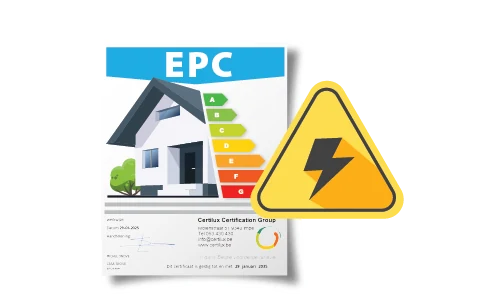
Combination package: EPC (energy performance certificate) + electrical inspection
Prices include 21% VAT and all costs
Great deals at Certilux! Take advantage of our discounts now!
| Region | Studio | Apartment | Duplex apartment | Triplex apartment | Terraced house | Semi-detached house | Detached house | Large house (> 250 m²) * |
|---|---|---|---|---|---|---|---|---|
| Flanders | was € 584€ 433 | was € 584€ 433 | was € 584€ 433 | was € 639€ 453 | was € 639€ 453 | was € 639€ 468 | was € 679€ 498 | was € 814€ 638 |
| Brussels | was € 644€ 513 | was € 644€ 513 | was € 744€ 618 | was € 754€ 628 | was € 784€ 628 | was € 834€ 653 | was € 834€ 683 | was € 1019€ 843 |
| Wallonia | was € 571€ 440 | was € 571€ 440 | was € 671€ 545 | was € 681€ 555 | was € 681€ 555 | was € 711€ 580 | was € 761€ 610 | was € 946€ 770 |
| Flanders | Brussels | Wallonia | |
|---|---|---|---|
| Studio | was € 584€ 433 | was € 644€ 513 | was € 571€ 440 |
| Apartment | was € 584€ 433 | was € 644€ 513 | was € 571€ 440 |
| Duplex apartment | was € 584€ 433 | was € 744€ 618 | was € 671€ 545 |
| Triplex apartment | was € 639€ 453 | was € 754€ 628 | was € 681€ 555 |
| Terraced house | was € 639€ 453 | was € 784€ 628 | was € 681€ 555 |
| Semi-detached house | was € 639€ 468 | was € 834€ 653 | was € 711€ 580 |
| Detached house | was € 679€ 498 | was € 834€ 683 | was € 761€ 610 |
| Large house (> 250 m²) * | was € 814€ 638 | was € 1019€ 843 | was € 946€ 770 |
* A large house is a home with a floor area of 250 m² to 350 m². If in doubt, choose the cheapest option; we will correct this after the site visit if necessary. For larger properties, you can request a quote here. The habitable floor area includes all areas of the living space, including converted and/or insulated attics. Detached garages, sheds, commercial buildings or other structures are not included. If in doubt, choose the cheapest option; we will correct this after the site visit if necessary.
Ready to order?
Please fill in all your details here. We will contact you very shortly. You can always cancel free of charge!
No online payment: you will receive an invoice by e-mail or post.
How we work
You can place your order online. An appointment for the site visit is made as soon as possible. Need help with the form, or would you rather order by phone? Call 053 430 430 every day between 8 am and 6 pm.
Once the appointment has been set, you will receive an e-mail confirming it, with the digital version of your invoice attached. The invoice can be paid by bank transfer, so there is no need to pay online through our website.
The certificate is delivered both digitally (by e-mail where available) and on paper (by post) within 48 hours of the site visit.
If you are selling your home, you may also need an electrical inspection. In that case, we recommend ordering a good-value combination package: EPC + electrical inspection.
What is an EPC or energy performance certificate?
The EPC is an energy report that shows how energy-efficient a home is. With the EPC, buyers and tenants can better estimate how much energy their new home will use. The energy score is calculated on the basis of the characteristics of the home, such as the presence and quality of insulation materials, the efficiency of the installations and the presence of energy-saving technologies (such as solar panels, a solar water heater, a heat pump, etc.). Because the energy score expresses energy consumption per square metre of living space per year, homes (large and small) can easily be compared with one another.
The EPC also contains a number of energy-saving recommendations. These recommendations are for information and awareness only and do not have to be carried out. Only accredited energy assessors may draw up an EPC. The energy assessor first inspects the home on site and then enters all the data into dedicated software to calculate the energy score and produce the EPC. The assessor signs the EPC and hands it to the owner of the home. In the case of a rental, the certificate is given to the landlord (and the tenant receives a copy from the landlord). When the home is sold, the EPC is handed over to the new owner. The EPC is valid for 10 years, even if the home is sold or let again.
Which buildings must have an EPC?
An EPC is mandatory for the sale and rental of every housing unit, so it must be drawn up for each house, each apartment, each studio, and so on. A housing unit is defined as any unit in a residential building that has the (living) facilities needed to function independently. This means that, in addition to a living area, a housing unit must have its own toilet, a shower or bath, and a kitchen or kitchenette. For student residences made up of student rooms without a bathroom and kitchen, an energy performance certificate must be drawn up for the building as a whole, as a student room without a bathroom and kitchen is not regarded as a separate housing unit.
How is an energy performance certificate drawn up?
As soon as you have placed your order, the energy assessor will phone you within 24 hours to make an appointment to inspect the home. On site, the assessor inspects the roof, walls, floor, windows and doors, the insulation materials used and the heating installations, following the inspection protocol drawn up by the Flemish Energy Agency (VEA). The assessor may not carry out any destructive investigation (for example, no drilling of holes); everything is assessed visually. The on-site inspection takes about 45 minutes on average.
When can the energy assessor visit, and do I need to be present?
The inspection can take place during the day or in the evening, as well as at weekends. It is best if someone is present, but it does not have to be you personally. Practical arrangements are made when the inspection appointment is set. Arrangements can be made with estate agents and notaries to collect the keys from, and return them to, their office.
Which documents can I have ready when the energy assessor comes to draw up the EPC?
The more documents you can provide, the more accurately the energy assessor can draw up the EPC. These documents are not mandatory; the energy assessor can also carry out an inspection without them. If you can still find the following documents, it is best to have them ready:
- the building specifications
- original invoices from a registered contractor
- original invoices for building materials
- original invoices for heating installations
- technical documentation for the heating installations
- 'as built' plan showing how your house was actually built. This may differ from the design plan the architect originally drew up.
- findings from site reports, the post-intervention file or progress statements
- a previously issued energy performance certificate
- an EPB declaration
- grant applications to the Flemish government
Will I receive the certificate immediately on site?
No, that is not possible, because the energy assessor first has to enter all the collected data into the online certification software at the office in order to calculate the energy score and produce the EPC.
Do I have to pay the energy assessor when they visit my home?
No. As soon as you have placed your order, you will immediately receive an invoice. You must transfer the amount due to the account number stated. The EPC will only be handed over once the invoice has been paid.
What is the delivery time?
The standard delivery time is between 3 and 14 days. If required, the customer can also receive the EPC more quickly.
How long is an energy performance certificate valid?
The EPC remains valid for 10 years. If the housing unit is sold or let again within this ten-year validity period, no new EPC needs to be drawn up.
What happens to the certificate when I sell or let my home?
In the case of a sale, the EPC is transferred to the new owner. In the case of a rental, the tenant receives a copy of the EPC.
If I have made changes to my home, do I need a new certificate?
No, as long as the certificate is valid you do not need a new one. However, if measures have since been taken that make the building more energy-efficient, such as replacing single glazing with insulating glazing, adding roof insulation, renewing the heating installation, or installing solar panels or a solar water heater, it is in your interest to have a new certificate drawn up, as the result will be better.
I have a recently built home and already have an energy performance certificate from when it was built. Do I need a new certificate?
No. If the home was built recently and an energy performance certificate for new buildings is therefore already available, no EPC for the sale or rental of residential buildings needs to be drawn up as long as the EPC for the new building is valid, i.e. 10 years.
In which cases is no EPC required?
Buildings that are not heated for human occupancy do not need an EPC. "Not heated" means there is no fixed heat generation or heat emission system. If the heating is faulty or not connected, the housing unit does still need an EPC for a sale or rental.
No certificate is required for the sale or rental of homes declared uninhabitable by the mayor, homes with an ordinary lease of less than 2 months, or expropriations through the purchasing committee.
An EPC is not required only in the cases above. A home that has been declared unfit is therefore still subject to the obligation.
Do I also need an EPC to rent out my holiday home or holiday apartment?
The Flemish Government has decided in principle that an EPC for residential buildings that are rented out only needs to be drawn up:
- in the case of an ordinary lease, insofar as the rental period is longer than two months.
- in the case of a residential lease (a residential lease applies to a home that is the tenant's main residence).
In practice, this means that holiday homes for which rental agreements are concluded for less than two months do not need an EPC.
Can I deduct the EPC from my taxes?
No, you cannot include the cost of the EPC in your tax return.
Can the cost of the EPC be passed on to the tenant?
The government does not impose any rules on this.
Is the EPC issued for a new building the same as the EPC drawn up for the sale and rental of existing homes?
No. The EPC for new buildings and major renovations contains different data from the EPC for sale and rental, and it also looks different. However, the EPC issued after new construction or renovation can be used for the sale and rental of the newly built or renovated home. So if you have received an EPC for a new building, you can also use it when you later want to let or sell your home (within the 10-year validity period), and you do not need to have a new one drawn up.
Electrical inspection on the sale of a property
When a residential property is sold, an inspection certificate for the electrical installation must be available when the sale agreement (the "compromis") is signed. The inspection must also be carried out again if the existing inspection certificate is more than 25 years old or if changes or extensions have been made. If the inspection is favourable, this is stated in the notarial deed. If the inspection is unfavourable, the buyer must remedy the defects within 18 months of the sale and request a re-inspection.
Who must request this inspection?
The owner of the installation. In the case of a sale, the seller must have the inspection carried out at their own expense. Buyer and seller are of course free to agree otherwise between themselves.
When must the inspection report be available?
The inspection report must be available when the sale agreement (compromis) is signed.
What if the buyer decides the inspection is unnecessary because they are going to demolish the building or completely renovate the electrical installation?
The seller can have it stated in the authentic deed that the buyer must inform the authorities in writing of the demolition of the housing unit or the complete renovation of the electrical installation. The authorities will send the buyer a file number and ask them to submit a favourable inspection report as soon as the new installation is put into service. The address to which the buyer must send the notification is "Algemene Directie Energie, Afdeling Infrastructuur, North Gate III, Koning Albertlaan 16 te 1000 Brussel".
What if the installation fails the inspection?
The seller must then have it stated in the authentic deed that the buyer is required to notify, in writing, the accredited body that carried out the inspection of the electrical installation of their identity and the date of the official deed of sale.
Depending on the defect(s), the new owner then has 12 to (usually) 18 months to bring the installation into compliance. The date by which the new inspection must be carried out is shown on the inspection report. The re-inspection may be carried out by a different inspection body from the one that carried out the first inspection.
If the new inspection finds that defects still remain, the Federal Public Service for Energy is notified.
Can the sale go ahead if the installation has failed the inspection?
It makes no difference whether the installation passed or failed: the sale can simply go ahead.
How long is a favourable inspection report valid?
A favourable inspection report is valid for 25 years.
What do I need for the inspection?
For the inspection you must provide a single-line diagram and a layout plan (showing the exact location of distribution boards, junction, branch and wall sockets, light points and switches).
How is the inspection carried out?
1. Administrative check: the single-line diagram and layout plan are checked
2. Visual check: the diagrams are compared with the actual installation, and the correct use and installation of the electrical equipment are checked.
3. Functional testing: this involves testing the residual current device(s).
4. Measurement: earthing, insulation, fault loop impedance and continuity are measured.
Certilux is not on the list of accredited bodies – why is that?
Certilux Certification Group has cooperation agreements with a number of inspection bodies accredited by the federal government. These bodies are subject to specific legal, organisational and technical requirements and are also very thoroughly monitored. Certilux Certification Group has itself selected a number of bodies that can offer their services through the group. Internally, too, quality, speed of delivery and customer service are closely monitored. What's more, with us you always get the best price!
Naturally, the bodies included in our group appear on the list of accredited inspection bodies, which can be found on the website of the FOD Economie, K.M.O., Middenstand en Energie (FPS Economy, SMEs, Self-Employed and Energy).