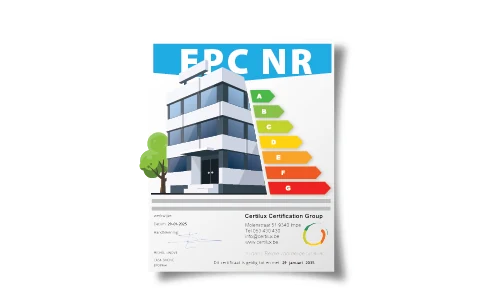
EPC NR (EPC for non-residential buildings)
The EPC NR (EPC for non-residential buildings) is an EPC (energy performance certificate) introduced by the Flemish government and, from 1 January 2026, it is mandatory for all offices, shops, schools, hospitals, and so on. This certificate is now required even if there is no transfer or rental.
But it is not just a mandatory certificate: it is the first step in a series of targets that will bring obligations and investments over the coming years. Anyone who does not adapt in time will face mandatory financial contributions.
Request your free quote for an EPC for non-residential buildings now!
What is an EPC NR?
An EPC NR is the energy performance certificate for non-residential buildings, such as offices, shops, schools or other commercial buildings. It differs fundamentally from the EPC for homes, because it takes into account the specific use and installations of the building. As a result, the EPC NR gives a much more detailed picture of the energy performance and the opportunities for improvement.
The certificate consists of two main parts:
- EPC score: an assessment of the insulation and the technical installations present. This gives insight into the general condition of the building and allows comparison with other similar buildings.
- EPC label: a classification based on actual energy consumption and the share of renewable energy generated on site. This determines which class the building falls into.
The EPC NR is therefore not just an administrative document but a practical tool for companies and institutions. It helps to make buildings more energy-efficient, reduce costs and comply with the legal obligations of the Flemish government.
At Certilux, we guide you step by step towards obtaining a correct EPC NR. This is not a one-off intervention but a lasting partnership that keeps you within the legal framework and supports you in running your business more cost-efficiently.
Guidance towards energy label E: smart advice tailored to your building
From 1 January 2030, all non-residential buildings in Flanders must demonstrate via the EPC NR that they achieve at least energy label E. This label is not only a legal obligation, but also an important step towards energy efficiency and a future-proof business.
Achieving label E means, among other things, that at least 5% of energy consumption must come from renewable sources – a requirement that is a challenge for many buildings.
At Certilux, we understand that every building is unique. That is why, in addition to drawing up the EPC NR, we also offer targeted guidance. We give you expert advice on how to improve your building step by step. Together we look at which measures are needed to meet the standard, which technologies deliver the best return and how to make the most of available grants.
Our guidance is not a one-off intervention but valuable long-term support. This way you stay within the legal framework, avoid fines and work purposefully towards an energy-efficient future.
Want to be sure your building meets the 2030 requirements in time? Contact Certilux and discover how our expertise can help you achieve energy label E efficiently and cost-effectively.
Which buildings need an EPC NR?
An EPC NR is mandatory for all non-residential building units, i.e. all units whose main function is 'non-residential' – in other words, all buildings that are not primarily used for housing, industry or agriculture.
Below is a non-exhaustive list:
- Office spaces:
- Estate agencies
- Notaries' offices
- Banks
- Insurance offices
- Accountancy firms
- Law firms
- IT companies
- Software companies
- Recruitment agencies
- Advisers and consultants
- Project managers
- Communication agencies
- …
- Shops and commercial premises
- Hospitals, residential care centres and doctors' surgeries
- Educational institutions (primary and secondary schools, colleges, universities)
- Sports facilities and fitness centres
- Hospitality businesses (restaurants, cafés, hotels)
- Government buildings (administrative and public service buildings)
Which buildings do not need an EPC NR?
- Residential buildings (houses and apartments).
- Industrial buildings and agricultural buildings.
- Non-residential buildings smaller than 50 m².
- Temporary structures with a period of use of less than 2 years.
- Buildings for which a demolition permit has been granted, with demolition planned within 5 years.
- Places of worship such as churches, mosques, synagogues, temples, etc.
- For small non-residential units (< 500 m²), we can draw up an EPC for small non-residential units (kNR) instead of an EPC NR.
- In the case of partial rental or transfer (e.g. only an office space within a larger whole).
What is the difference between an EPC kNR and an EPC NR?
There are two types of energy performance certificate for non-residential buildings: the EPC kNR (small non-residential units) and the EPC NR. Both give insight into energy efficiency, but they were developed for different types of building and have a different level of detail.
The EPC kNR is intended for compact non-residential spaces, such as a small shop, practice room or small café or restaurant. It uses a simplified calculation method and applies to buildings with a floor area of less than 500 m². The certificate gives a general energy score and practical recommendations, but does not include an energy label.
The EPC kNR is therefore a practical solution for small premises, but should be seen rather as a way of being administratively compliant.
Who is responsible for drawing up an EPC NR, the owner or the tenant?
It is always the building owner or their authorised representative who is responsible for having the EPC NR drawn up. The tenant is obliged to provide access to the buildings for the inspection and to supply the necessary information on meter readings and energy consumption.
How long is an EPC NR valid?
An EPC NR is valid for 5 years from the date it is drawn up. The EPC NR expires if the use of the building unit changes (for example from non-residential to residential or industrial) or if a new EPC is submitted.
Request your free quote for an EPC for non-residential buildings now!
To measure is to know: the foundation of a correct EPC NR
An EPC NR is much more than a certificate. It is a tool that maps the energy performance of a non-residential building and points the way to future improvements. And that starts with one crucial step: measuring correctly.
The EPC NR looks not only at insulation and technical installations, but also at the actual energy consumption of the building. This means we do not work with assumptions, as with residential EPCs, but with real consumption data. How much electricity and heat is consumed? How much of it comes from renewable sources? And how does that relate to total energy demand?
To answer these questions, meters and metering data are indispensable. They form the basis of the EPC label, which determines which class your building falls into. Without reliable measurements, it is impossible to calculate a correct score or to meet the standard of at least 5% renewable energy by 2030.
At Certilux, we guide you through this process. We advise on which metering data are needed, how to collect them and how best to prepare your building for correct and efficient certification. Because measuring is not only knowing – it is also the key to an energy-efficient future and legally compliant business operations.
We also offer a service for the mandatory annual meter reading.
Want to be sure of a correct EPC NR score and a clear path towards energy label E? Contact Certilux for expert guidance.
Can any energy meter be used?
No. With a method based on energy measurements, the quality of the measurements is crucial for a correct assessment of the energy label. This applies both to the quality of the meters and to the recorded readings themselves.
The meters must be sufficiently accurate, used correctly and representative of the use within the scope. More information about energy meters can be found here.
Is an annual meter reading mandatory for the EPC NR?
Yes, an annual meter reading is mandatory for an EPC NR. Energy consumption must be recorded at least once a year, each time in the same month. "The same month" means the reference month used in the initial EPC NR. The owner can submit the data themselves each year. If preferred, a contract can also be concluded under which Certilux visits the site every year to take the meter readings.
Is the EPC NR comparable to the EPC for a home?
An energy performance certificate for non-residential buildings (EPC NR) is not the same as the EPC you know from homes. Both relate to energy efficiency, but they are structured differently and have a different purpose.
EPC for homes
This certificate is based on the standard use of a house. It works with fixed assumptions about heating, ventilation and hot water. The result is a clear label from A to F, which helps occupants better understand their energy consumption.
EPC NR for non-residential buildings
Here, the specific use of the building is taken into account: an office, shop, school and so on. This makes the calculation much more complex and less universal. Moreover, the score is expressed using a different indicator, which is less easy for a layperson to interpret.
Non-residential buildings often have very diverse installations and energy needs. That is why an EPC NR cannot simply be compared with a residential EPC. The residential EPC is mainly intended to raise awareness among occupants, whereas the EPC NR is intended as a practical tool for companies and institutions to make their buildings more energy-efficient.
In short: on paper they may seem related, but in practice they are two completely different certificates. Comparing them would be like comparing apples and oranges.
The EPC for non-residential buildings has two results
EPC score: this tells you how a building scores in terms of insulation and the technical installations present. It gives a good idea of the condition of a building and allows comparison with other similar buildings.
EPC label: this label "measures" what you actually consume and compares the share of renewable energy generated on site with total energy consumption. On that basis, you fall into a particular class.
I have a practice in my home. Do I need an EPC NR?
If the practice space is smaller than 50 m², it does not form a separate building unit, and an EPC NR is not required.
If the practice space is 50 m² or larger, the following must be assessed further:
Does the practice space form an independently functioning unit? If it has a separate toilet, it functions independently. It must also be assessed whether the practice space is directly accessible from the street or via a shared entrance hall or stairwell, and whether the entrance can be locked. In addition, there must be no door between the living area and the practice.
If these conditions are met, an EPC NR (or kNR) must be drawn up for the practice.
If not, the use with the largest floor area takes precedence. If the practice is larger than the living area, an EPC NR (or kNR) must be drawn up.
The same naturally applies to an office, a commercial space or any other use of a non-residential nature.
What is the Flemish government's objective?
The ultimate objective is for every non-residential building to be carbon-neutral (class A) by 2050.
This means:
- Reducing energy consumption as much as possible through better insulation and more efficient installations (improving the EPC score).
- Generating all remaining energy consumption from renewable sources on site. The end result is that every site functions autonomously, with the possibility of feeding temporary surpluses into the grid.
The Flemish government has a step-by-step plan with associated annual fines of between €500 and €5000. For example, every EPC NR must meet class E by 2030.
At Certilux, we can advise you on how this can be achieved in your specific situation. An EPC NR is not a one-off intervention, but a long-term partnership that keeps you within the legal framework and guides you towards running your business more cost-efficiently.
Key dates and deadlines
- Since 1 January 2023: Mandatory on the sale of non-residential buildings, the granting of a long lease (erfpacht) or building rights (opstalrecht), or a new lease.
- 1 January 2024: Obligation for public buildings. The old "EPC Publiek" can no longer be used for the display obligation.
- 1 January 2025: Large non-residential building units (≥1000 m²) must have an EPC NR, regardless of sale or rental.
- 1 January 2026: All non-residential units must have an EPC NR, regardless of size.
- 1 January 2028: A minimum share of 5% renewable energy (label E) becomes mandatory for large building units of public and government buildings (except for community education and subsidised education).
- By 2030: Every non-residential building must achieve at least label E (equal to 5% renewable energy).
- By 2050: Flanders aims for carbon neutrality for every non-residential building unit (label A).
Which renewable sources have a positive effect on the EPC NR label?
The label of the EPC for non-residential buildings is calculated on the basis of the percentage of renewable energy in relation to total energy consumption. This percentage is expressed using the term long-term target indicator (ILTD).
The renewable sources that qualify are:
- Energy generated by sun, wind or hydropower.
- Ambient heat via a heat pump.
- CHP, boiler or stove running on biomass or biofuel produced on site.
- The renewable share of waste heat from waste incineration.
- Renewable heat supplied via an external heat network.
- Recovered waste heat from a cooling installation, server room, etc.
Why is the renewable energy from my solar panels not counted when I have a reverse-running electricity meter?
With a reverse-running meter, it is not possible to measure the amount of electricity fed into the grid, unless a separate meter is installed.
Because the electricity fed into the grid is not known, the self-consumption of the solar panels cannot be calculated correctly. As a result, this consumption is not counted in the share of renewable energy.
Do I need to own the solar panels that supply my building(s) with solar energy?
You do not need to own the solar panels yourself; they can also be owned by third parties. There is, however, an important caveat: the photovoltaic installation must be connected directly to your scope. As soon as an external grid is used (even, for example, to cross the street), the energy is no longer considered to be generated locally.
Will a battery in addition to my solar panels contribute to a better EPC NR?
Within the EPC for non-residential buildings, installing one or more batteries can have a positive effect on the energy label.
The result will, however, always depend on the specific situation and actual energy consumption. It is therefore important to always seek proper advice from your energy assessor.
Legislation and useful links on the EPC NR
The EPC NR is not an optional measure, but a legal obligation imposed by the Flemish government.
The legal basis can be found in the Energy Decree (Energiedecreet) and the Energy Order (Energiebesluit), which set out the obligations, penalties and accreditation of energy assessors. These documents form the foundation of EPC regulations in Flanders.
For more information and practical guidelines, please visit the following official websites:
- Vlaanderen.be – EPC NR explanation and obligations (in Dutch)
- Vlaanderen.be – EPC regulations and Energy Decree (in Dutch)
We can issue an EPC NR in the following municipalities:
- Aalst
- Aalter
- Aarschot
- Aartselaar
- Affligem
- Alken
- Alveringem
- Antwerpen
- Anzegem
- Ardooie
- Arendonk
- As
- Asse
- Assenede
- Avelgem
- Baarle-Hertog
- Balen
- Beernem
- Beerse
- Beersel
- Begijnendijk
- Bekkevoort
- Beringen
- Berlaar
- Berlare
- Bertem
- Bever
- Beveren-Kruibeke-Zwijndrecht
- Bierbeek
- Bilzen-Hoeselt
- Blankenberge
- Bocholt
- Boechout
- Bonheiden
- Boom
- Boortmeerbeek
- Bornem
- Boutersem
- Brakel
- Brasschaat
- Brecht
- Bredene
- Bree
- Brugge
- Buggenhout
- Damme
- De Haan
- De Panne
- Deerlijk
- Deinze
- Denderleeuw
- Dendermonde
- Dentergem
- Dessel
- Destelbergen
- Diepenbeek
- Diest
- Diksmuide
- Dilbeek
- Dilsen-Stokkem
- Drogenbos
- Duffel
- Edegem
- Eeklo
- Erpe-Mere
- Essen
- Evergem
- Gavere
- Geel
- Geetbets
- Genk
- Gent
- Geraardsbergen
- Gingelom
- Gistel
- Glabbeek
- Grimbergen
- Grobbendonk
- Haacht
- Haaltert
- Halen
- Halle
- Hamme
- Hamont-Achel
- Harelbeke
- Hasselt
- Hechtel-Eksel
- Heers
- Heist-op-den-Berg
- Hemiksem
- Herent
- Herentals
- Herenthout
- Herk-de-Stad
- Herselt
- Herstappe
- Herzele
- Heusden-Zolder
- Heuvelland
- Hoegaarden
- Hoeilaart
- Holsbeek
- Hooglede
- Hoogstraten
- Horebeke
- Houthalen-Helchteren
- Houthulst
- Hove
- Huldenberg
- Hulshout
- Ichtegem
- Ieper
- Ingelmunster
- Izegem
- Jabbeke
- Kalmthout
- Kampenhout
- Kapellen
- Kapelle-op-den-Bos
- Kaprijke
- Kasterlee
- Keerbergen
- Kinrooi
- Kluisbergen
- Knokke-Heist
- Koekelare
- Koksijde
- Kontich
- Kortemark
- Kortenaken
- Kortenberg
- Kortrijk
- Kraainem
- Kruisem
- Kuurne
- Laakdal
- Laarne
- Lanaken
- Landen
- Langemark-Poelkapelle
- Lebbeke
- Lede
- Ledegem
- Lendelede
- Lennik
- Leopoldsburg
- Leuven
- Lichtervelde
- Liedekerke
- Lier
- Lierde
- Lievegem
- Lille
- Linkebeek
- Lint
- Linter
- Lochristi
- Lokeren
- Lommel
- Londerzeel
- Lo-Reninge
- Lubbeek
- Lummen
- Maarkedal
- Maaseik
- Maasmechelen
- Machelen
- Maldegem
- Malle
- Mechelen
- Meerhout
- Meise
- Menen
- Merchtem
- Merelbeke-Melle
- Merksplas
- Middelkerke
- Mol
- Moorslede
- Mortsel
- Nazareth-De Pinte
- Niel
- Nieuwerkerken
- Nieuwpoort
- Nijlen
- Ninove
- Olen
- Oostende
- Oosterzele
- Oostkamp
- Oostrozebeke
- Opwijk
- Oudenaarde
- Oudenburg
- Oud-Heverlee
- Oudsbergen
- Oud-Turnhout
- Overijse
- Peer
- Pelt
- Pepingen
- Pittem
- Poperinge
- Putte
- Puurs-Sint-Amands
- Ranst
- Ravels
- Retie
- Riemst
- Rijkevorsel
- Roeselare
- Ronse
- Roosdaal
- Rotselaar
- Rumst
- Schelle
- Scherpenheuvel-Zichem
- Schilde
- Schoten
- Sint-Genesius-Rode
- Sint-Gillis-Waas
- Sint-Katelijne-Waver
- Sint-Laureins
- Sint-Lievens-Houtem-Oosterzele
- Sint-Martens-Latem
- Sint-Niklaas
- Sint-Pieters-Leeuw
- Sint-Truiden
- Spiere-Helkijn
- Stabroek
- Staden
- Steenokkerzeel
- Stekene
- Temse
- Ternat
- Tervuren
- Tessenderlo-Ham
- Tielt
- Tielt-Winge
- Tienen
- Tongeren-Borgloon
- Torhout
- Tremelo
- Turnhout
- Veurne
- Vilvoorde
- Vleteren
- Voeren
- Vorselaar
- Vosselaar
- Waasmunster
- Waregem
- Wellen
- Wemmel
- Wervik
- Westerlo
- Wetteren
- Wevelgem
- Wezembeek-Oppem
- Wichelen
- Wielsbeke
- Wijnegem
- Willebroek
- Wingene
- Wommelgem
- Wortegem-Petegem
- Wuustwezel
- Zandhoven
- Zaventem
- Zedelgem
- Zele
- Zelzate
- Zemst
- Zoersel
- Zonhoven
- Zonnebeke
- Zottegem
- Zoutleeuw
- Zuienkerke
- Zulte
- Zutendaal
- Zwalm
- Zwevegem